Highest RTP slots: the best payout games and how to check them
The slots with the highest published RTP, from Mega Joker and Blood Suckers to White Rabbit Megaways, and why the same game can pay back less at one casino than another.


Return to player (RTP) is the share of all money wagered on a slot that it pays back over the very long run. Most modern slots sit around 96%, which means the game keeps about C$4 of every C$100 wagered on average. A handful of games go much higher. This guide lists the best-known high-RTP slots, explains the catches behind the headline numbers, and shows you how to check the RTP of any game at your casino before you play.
The short version
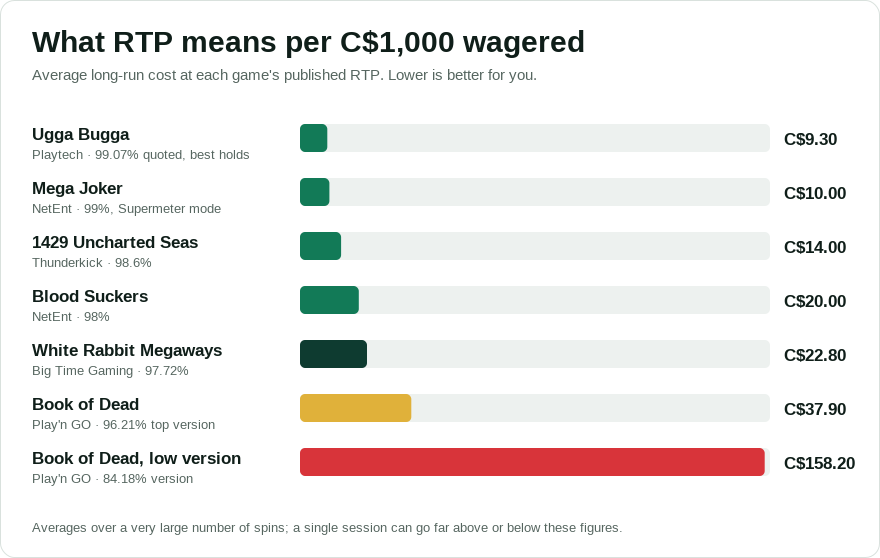
- The best-known high-RTP slots include Mega Joker (up to 99%), Ugga Bugga (99.07% quoted), 1429 Uncharted Seas (98.6%), Blood Suckers (98%) and White Rabbit Megaways (97.72%).
- Many slots come in several RTP versions, and the casino chooses which one to run. Book of Dead, for example, ranges from 96.21% down to 84.18%.
- The RTP is shown in the game’s help or paytable screen. Check it every time, at every casino.
- A higher RTP lowers the average cost of playing. It does not make any single session more likely to win.
What RTP really means
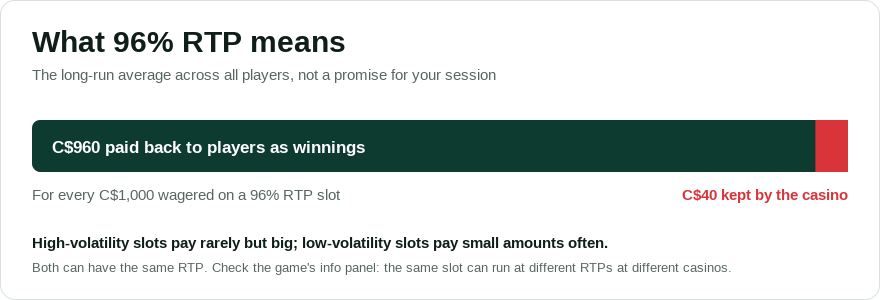
RTP is a long-run average calculated over millions of spins, not a promise for your session. A slot with a 97% RTP is expected to return C$970 for every C$1,000 wagered across all players over its lifetime. The other 3% is the house edge. Our guide to RTP and volatility goes into the maths; the key points are:
- RTP is about the game, not you. Individual results swing far above and below it, especially on high-volatility slots.
- The difference compounds. Slots are fast. At 600 spins an hour, a C$1 bet means C$600 wagered per hour, so a few percentage points of RTP become real money over an evening.
- Bonus features count. On many slots a large share of the RTP comes from free spins and bonus rounds, so you can go a long time without seeing it.
The highest RTP slots
These are the best-known slots with an RTP well above the usual 96%, with the figures published by the studio or reported consistently by independent slot databases. Availability differs between casinos and provinces, and a casino may run a lower version, so treat these as the maximum, not a guarantee.
| Slot | Studio | Top published RTP | Volatility | The catch |
|---|---|---|---|---|
| Ugga Bugga | Playtech | 99.07% | Low | Playtech does not publish per-game RTPs; the figure assumes you make the best hold choices |
| Mega Joker | NetEnt | 99% | High | 99% applies in Supermeter mode at set stakes, not to ordinary spins |
| 1429 Uncharted Seas | Thunderkick | 98.6% | Low | Some casinos list a lower 98% version |
| Blood Suckers | NetEnt | 98% | Low | An older game with a modest top prize |
| White Rabbit Megaways | Big Time Gaming | 97.72% | High | Large swings; most of the return sits in the free spins |
| Book of Dead | Play’n GO | 96.21% | Very high | Also exists at 94.25%, 91.25%, 87.25% and 84.18% |
| Starburst | NetEnt | 96.09% | Low | Six versions, from 96.09% down to 90.05% |
Book of Dead and Starburst are not high-RTP games, but they are among the most played slots in Canada and show how much the version matters. Sources: TopEndSports’ provider-checked list on Mega Joker and Ugga Bugga; OLBG on the Book of Dead and Starburst versions; OLBG on 1429 Uncharted Seas; Gambling.com on White Rabbit Megaways.
Same slot, different RTP
This is the part most “best payout slots” lists leave out. Many studios now certify the same game at several RTP settings, and each casino picks the one it runs. The game looks and plays identically; only the payout maths differs.
The effect is large. On Book of Dead, the difference between the 96.21% version and the 84.18% version is the difference between losing about C$38 and about C$158 per C$1,000 wagered, on average. Starburst ranges from 96.09% to 90.05%. Even a slot known for a high RTP can appear in a lower version: 1429 Uncharted Seas is listed at 98.6% by most databases but at 98% at some casinos.
Regulated casinos in Ontario and Alberta must use games that independent test labs have certified, so each version pays what its certificate says. But no rule requires a casino to run the highest version. That choice is commercial. Our guide on how casino games are tested explains the certification process.
How to check a slot’s RTP before you play
- Open the game, in demo mode if the casino offers it, or with the smallest stake.
- Find the information screen. Look for an “i”, a question mark, “Paytable”, “Game rules” or “Help” in the menu.
- Search the rules for “RTP”, “return to player” or “theoretical return”. Studios list the figure in the rules, sometimes near the end.
- Compare it with the top published figure. If the number is lower than the table above, you are playing a reduced version.
- Check again at another casino if you play the game often. The same title may run at a higher RTP elsewhere.
If a game’s rules do not show an RTP at all, that is worth noticing. Most reputable studios publish one in every game.
RTP and volatility together
RTP tells you the average cost. Volatility tells you how bumpy the ride is on the way there. Two slots with the same 97% RTP can feel completely different:
- Low volatility (Blood Suckers, 1429 Uncharted Seas, Starburst): frequent small wins, smaller top prizes, a balance that moves slowly. Good for longer sessions on a fixed budget.
- High volatility (White Rabbit Megaways, Book of Dead, Mega Joker): long dry spells, occasional large wins. Your actual return over a few hundred spins can be far from the RTP in either direction.
If you care about making a budget last, a high RTP with low volatility is the combination to look for. If you are chasing a big win, accept that a high-volatility game will often finish a session well below its RTP.
What about jackpot slots?
Progressive jackpot slots usually have a lower base RTP, because part of every bet goes into the jackpot pool. The published RTP often includes the jackpot’s contribution, which you will almost certainly never win. If RTP matters to you, compare the base-game RTP. Our jackpot slots guide explains how the pools are built.
Slots compared with table games
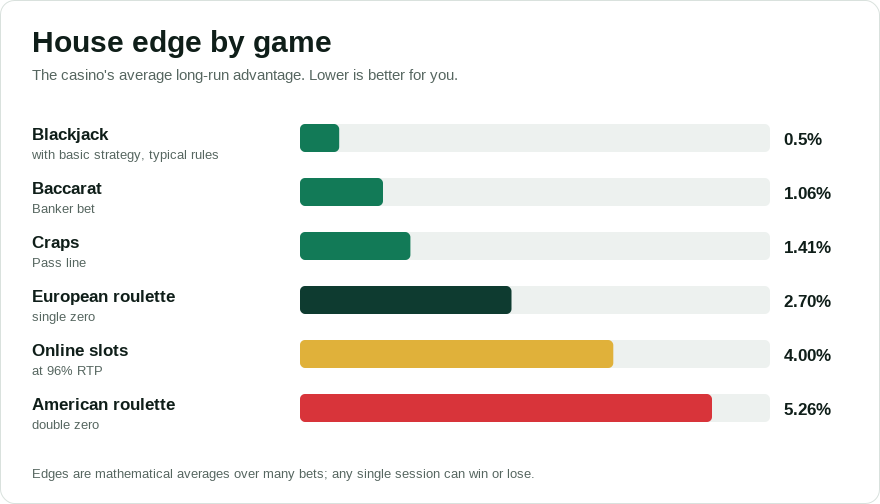
Even the best slots rarely beat the best table bets. Blackjack played with basic strategy has a house edge around 0.5%, the banker bet in baccarat about 1.06% and European roulette 2.70%. A 98% slot has a 2% edge, which puts it alongside European roulette, and a typical 96% slot is more expensive than all of them. The difference is that table games give you fewer, slower decisions per hour, which also lowers the cost of an evening.
Five RTP myths
- “This slot is due a win.” Every spin is independent. A slot that has not paid for an hour is no more likely to pay on the next spin. RTP is reached over millions of spins, not by balancing out your session.
- “Hot and cold slots.” Live statistics showing that a game paid more than its RTP in the last few hours describe the past, not the future. Short-run results on any slot vary hugely.
- “Bigger bets get a better RTP.” On almost every modern slot, the RTP is the same at every stake. Mega Joker is a rare exception, because its 99% figure depends on playing Supermeter mode at set coin values.
- “Bonus buys improve your odds.” Some games pay a slightly different RTP when you buy the bonus feature, sometimes higher, sometimes lower. Check the rules screen; a higher RTP on a bonus buy still comes with much larger swings.
- “Online slots are rigged.” At regulated Ontario and Alberta sites, slots are certified by independent test labs and must pay according to their certified maths. The risk is higher at unlicensed sites, where nobody checks.
How we put this list together
We do not play or test slots ourselves. The figures on this page come from studios’ published information where it exists, and from independent slot databases that check provider pages and in-game rules. Where sources disagree, as with 1429 Uncharted Seas, we say so. Where the studio does not publish a figure, as with Playtech’s Ugga Bugga, we flag it. RTPs can change when studios release new versions, so the game’s own information screen at your casino is always the final word.
Where high-RTP slots fit in Canada
Licensed Ontario and Alberta casinos carry libraries of hundreds or thousands of slots from many studios, but each casino chooses its own titles and versions, and not every game on this page is offered everywhere. Use the game information screen as your final check. Our online slots guide covers where to play by province, and our casino rankings show each brand’s licence and Trust Index.
A quick checklist for choosing a slot
- Check the RTP in the rules screen and compare it with the top published figure.
- Match the volatility to your budget. Low volatility for long sessions, high volatility only with money you are ready to lose quickly.
- Look at the maximum win. A 98% slot with a 1,000x cap pays out in small amounts; a 96% slot with a 10,000x cap saves its return for rare big hits.
- Try the demo first where the casino offers one, so you know how the features work before staking real money.
- Set a stop point for both losses and wins before you start.
Play for fun, not to recover losses
A high RTP slot still has a house edge, so the longer you play, the more likely you are to finish behind. Set a budget and a time limit before you start, and use the deposit and session limits that regulated sites must offer. If you find yourself playing to win back losses, stop and look at our responsible gambling page for free help in every province.
Frequently asked questions
Which slot has the highest RTP?
Among widely known games, Ugga Bugga is quoted at 99.07% and Mega Joker publishes up to 99% in Supermeter mode. 1429 Uncharted Seas (98.6%) and Blood Suckers (98%) are the highest among ordinary video slots.
Is RTP the same at every casino?
No. Many slots come in several certified RTP versions and each casino chooses which one to run. Check the game’s information screen at your casino.
Does a high RTP slot mean I will win?
No. RTP is a long-run average across all players. Any single session can win or lose, especially on high-volatility games.
Where do I find a slot's RTP?
In the game’s help, rules or paytable screen, usually reached through an i or question-mark icon. Search the rules for RTP or theoretical return.
What is a good RTP for a slot?
Around 96% is typical. Anything above 97% is high, and 98% or more is rare. Below 94% is low.