Moneyline, point spread and totals explained
The three bets behind almost every game on a sportsbook: who wins, by how much, and how many points are scored. How each works, with worked hockey and football examples.


Open any game on a Canadian sportsbook and the first three markets you see are almost always the same: the moneyline, the spread (called the puck line in hockey and the run line in baseball) and the total. Together they make up most of what people bet on. This guide explains how each one works, how to read the prices, what happens on a tie or an exact result, and when one bet type makes more sense than another.
The short version
- Moneyline: you pick who wins. The favourite pays less, the underdog more.
- Point spread: the favourite has to win by more than a set margin, and the underdog can lose by less than it and still win your bet.
- Total (over/under): you bet on whether both teams combined score more or fewer than a set number.
- Every price contains the sportsbook’s margin. Comparing prices between books is the simplest way to pay less of it.
Betting on single games in Canada
Until 2021, Canadians could only bet on single games through parlays. The Criminal Code amendments on single-event sport betting came into force on August 27, 2021, and provinces now decide how it is offered. In Ontario and Alberta you can bet with privately run, regulated sportsbooks; elsewhere the provincial lottery corporation’s site is the regulated option. Our single-event betting guide covers the details by province, and sports betting in Canada ranks the sportsbooks.
The moneyline: who wins
A moneyline bet is the simplest bet in sports: you pick the team or player you think will win. The price tells you how much you win and, in reverse, how likely the sportsbook thinks that outcome is.
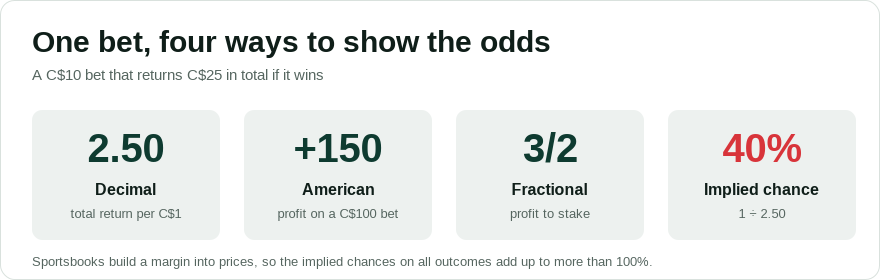
Canadian sportsbooks let you show prices as decimal or American odds. Our guide to reading betting odds covers both; here is the short form:
- Decimal odds show your total return per dollar staked. At 1.67, a C$10 bet returns C$16.70, including your stake.
- American odds with a minus sign show how much you must stake to win C$100: at −150, you stake C$150 to win C$100. With a plus sign, they show how much a C$100 stake wins: at +130, a C$100 bet wins C$130.
Every price implies a probability. For a minus price, divide the price by itself plus 100: −150 implies 150 ÷ 250 = 60%. For a plus price, divide 100 by the price plus 100: +130 implies 100 ÷ 230 = 43.5%. In decimal, divide 1 by the price. Our odds converter does this for you.
Add the two sides of a market together and you get more than 100%: in the example below, 60% plus 43.5% is 103.5%. The extra 3.5% is the sportsbook’s margin, the price you pay for every bet.
One game, priced three ways
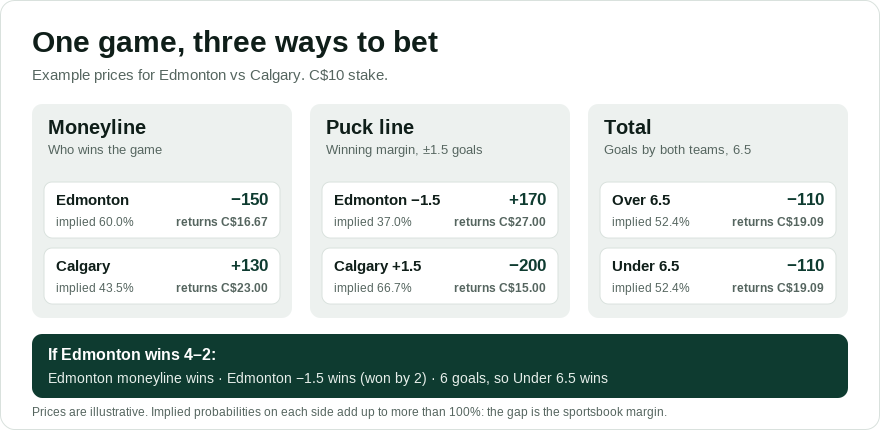
Here is how a single hockey game might be priced in all three markets. The prices are illustrative, but the structure is exactly what you will see on any sportsbook.
Edmonton is the favourite at −150 on the moneyline: a C$10 bet returns C$16.67 if they win. Calgary, the underdog at +130, returns C$23. On the puck line the picture flips. Edmonton at −1.5 has to win by two goals or more, which happens less often, so it pays a plus price, +170. Calgary at +1.5 wins the bet if they win or lose by one, so it costs more, −200. The total is set at 6.5 goals, with the over and the under both at −110.
If Edmonton wins 4–2, three different bets win at once: the Edmonton moneyline, Edmonton −1.5 (they won by exactly two) and the under (six goals in total). If Edmonton had won 3–2 instead, the moneyline would still win, but Calgary +1.5 would win the puck line, and the under would still win.
The point spread: by how much
A point spread evens out a mismatch. The sportsbook gives the favourite a handicap and the underdog a head start, and you bet on the result after the handicap is applied.
- Favourite −7.5: your bet wins only if the favourite wins by 8 or more.
- Underdog +7.5: your bet wins if the underdog wins outright or loses by 7 or fewer.
Because the spread does the work of evening things out, both sides of a typical football or basketball spread are priced close to even, commonly −110 (1.91) each way.
The spread has different names and habits in each sport:
- Hockey (puck line). Almost always ±1.5 goals. Because most NHL games are decided by one or two goals, the price does the balancing: the favourite at −1.5 usually pays a plus price, and the underdog at +1.5 a minus price. Our NHL betting guide explains why empty-net goals matter so much here.
- Baseball (run line). Also usually ±1.5 runs, priced the same way.
- Football. Spreads vary game to game, and some margins matter more than others: many NFL games end with a gap of three or seven points, so a half point either side of those numbers can be worth a lot. See our NFL betting guide.
- Basketball. Spreads are larger and scores higher, so single points matter less than in football.
A worked football example
Football shows how a spread changes the bet. Suppose Toronto is a 6.5-point favourite over Hamilton in a CFL game, with both sides at −110 (1.91):
| Final score | Toronto −6.5 | Hamilton +6.5 | Toronto moneyline |
|---|---|---|---|
| Toronto 31, Hamilton 20 | Wins (by 11) | Loses | Wins |
| Toronto 24, Hamilton 20 | Loses (by 4) | Wins | Wins |
| Hamilton 27, Toronto 24 | Loses | Wins | Loses |
The middle row is the one that surprises new bettors: Toronto won the game, but a spread bet on Toronto lost because they did not cover. The underdog bettor won without Hamilton winning. That is the trade-off of the spread: the favourite pays close to even money instead of a short moneyline price, but has to win by enough. Our CFL betting guide covers the Canadian game’s scoring quirks, such as the single point.
Totals: how many points
A total, or over/under, is a bet on the combined score of both teams. If the total is 6.5 goals, the over wins with 7 or more and the under wins with 6 or fewer. You do not need to pick a winner at all, which is why totals appeal to bettors who have a view on pace or goaltending but not on the result.
Sportsbooks also offer team totals (goals by one team) and period or half totals. The principle is the same.
Alternate lines and live betting
Most sportsbooks also offer alternate spreads and totals: the same game at other numbers, such as Edmonton −2.5 or a total of 5.5, each with its own price. Moving the number in your favour costs you price, and moving it against you pays more. Alternate lines are useful when you have a specific view, but they usually carry a larger margin than the main line.
During a game, the same three markets are repriced continuously as live bets. The logic does not change, but prices move fast and the margin is often higher, so it pays to know the main markets well before betting in play.
Pushes and half points
When a spread or total is a whole number, the result can land exactly on it. That is a push: your stake is returned, and nobody wins.
- Total 6, final score 4–2: push.
- Favourite −3, wins by exactly 3: push.
That is why many lines end in .5: a half point makes a push impossible. When you see the same game at different numbers at different sportsbooks, say −2.5 at one and −3 at another, the half point changes how often your bet wins, and comparing prices and numbers is worth the effort. Our line shopping guide shows how much this adds up to over a season.
Which bet type should you use?
| Bet | You are predicting | Best when | Watch out for |
|---|---|---|---|
| Moneyline | The winner | You like an underdog to win outright, or the sport is low scoring (hockey, baseball, soccer) | Big favourites pay very little and still lose sometimes |
| Spread / puck line | The margin | You expect a clear win, or think an underdog will keep it close | Late goals and garbage-time points can flip the result |
| Total | Combined score | You have a view on pace, injuries, goaltending or weather | Overtime counts at most sportsbooks; check the rules |
Rules worth checking before you bet
- Does overtime count? At most sportsbooks, NHL moneylines, puck lines and totals include overtime and the shootout, while a separate “60-minute” or “regulation time” market does not. Check the market name and the house rules.
- Three-way markets. In soccer and in 60-minute hockey markets, the draw is a separate outcome. If you back a team and the game is tied, you lose.
- Postponed or shortened games. Each sportsbook sets its own rules for games that are postponed or stopped early. Most void the bet if the game is not played within a set time.
- Line changes. The price you see when you place the bet is the one you get. Lines move with news and money, so a price can be gone a minute later.
The cost built into every line
On a balanced spread or total priced at −110 on both sides, you stake C$110 to win C$100 either way. Each side implies 52.4%, together 104.8%, and you need to win 52.4% of such bets just to break even. That margin is why most bettors lose over time even when they pick a little better than half their games correctly.
Three ways to pay less of it:
- Compare prices. Two or three sportsbook accounts let you take the best price on each bet.
- Prefer main markets. Moneylines, spreads and totals on major leagues usually carry smaller margins than props and parlays.
- Be careful with parlays. Combining bets multiplies the margin as well as the payout. See parlays explained.
Bet within your limits
Understanding how lines work makes betting clearer, not profitable by default. Decide on a budget before the season, use the deposit limits that regulated Ontario and Alberta sportsbooks must offer, and avoid chasing losses. Our bankroll management guide explains staking plans, and responsible gambling lists free help in every province.
Frequently asked questions
What does a moneyline bet mean?
It is a bet on who wins the game. The favourite pays less and the underdog pays more, with no point spread involved.
What does −1.5 mean in hockey betting?
It is the puck line. A bet on a team at −1.5 wins only if that team wins by two goals or more. A bet at +1.5 wins if the team wins, or loses by one goal.
What happens if the total lands exactly on the number?
It is a push and your stake is returned. Totals ending in .5, such as 6.5, cannot push.
Does overtime count in NHL betting?
At most sportsbooks, yes for the standard moneyline, puck line and total. Markets labelled 60-minute or regulation time exclude overtime and the shootout.
How do I work out the implied probability of odds?
For a minus price, divide it by itself plus 100 (−150 gives 60%). For a plus price, divide 100 by the price plus 100 (+130 gives 43.5%). For decimal odds, divide 1 by the price.