Poker hand rankings: all 10 hands, in order, with the odds
The ten poker hands from royal flush down to high card, how often each one is dealt, and how kickers, ties and split pots are settled.


Every form of poker you are likely to play in Canada, from Texas Hold’em at a home game to video poker at an Ontario online casino, uses the same ladder of hands. Learn the order once and it applies everywhere. This guide lists all ten hands from strongest to weakest, shows how rare each one is, and explains the parts that confuse new players most: kickers, ties and split pots.
The short version
- From strongest to weakest: royal flush, straight flush, four of a kind, full house, flush, straight, three of a kind, two pair, one pair, high card.
- Rarer hands beat more common ones. A flush (about 1 in 509 five-card hands) beats a straight (about 1 in 255).
- Suits never decide a winner in standard poker. Equal hands split the pot.
- When two players have the same type of hand, the higher cards win, then the kickers.
The ten poker hands, in order
A poker hand is always five cards. In games where you have more than five cards available, such as Texas Hold’em, you make the best five-card hand you can and the rest are ignored.
- Royal flush. A, K, Q, J and 10, all of one suit. It is simply the highest possible straight flush, and it cannot be beaten.
- Straight flush. Five cards in sequence, all of one suit, such as 9-8-7-6-5 of hearts. Between two straight flushes, the one with the higher top card wins.
- Four of a kind. Four cards of the same rank, such as four queens, plus any fifth card. Higher fours beat lower ones.
- Full house. Three of a kind plus a pair, such as three eights and two kings (“eights full of kings”). The three of a kind decides which full house is higher; the pair only matters if the threes are equal.
- Flush. Any five cards of the same suit that are not in sequence. Flushes are compared by their highest card, then the next, and so on.
- Straight. Five cards in sequence in mixed suits, such as 10-9-8-7-6. The ace can be high (A-K-Q-J-10) or low (5-4-3-2-A, called the wheel), but a straight cannot wrap around: Q-K-A-2-3 is not a straight.
- Three of a kind. Three cards of the same rank and two unrelated cards. In Hold’em, three of a kind made with a pocket pair is called a set, and with one hole card and a pair on the board, trips.
- Two pair. Two different pairs plus a fifth card, such as jacks and fours with an ace. The higher pair is compared first, then the lower pair, then the fifth card.
- One pair. Two cards of the same rank and three unrelated cards.
- High card. None of the above. The hand is named after its highest card: “ace high”.
How often each hand comes up
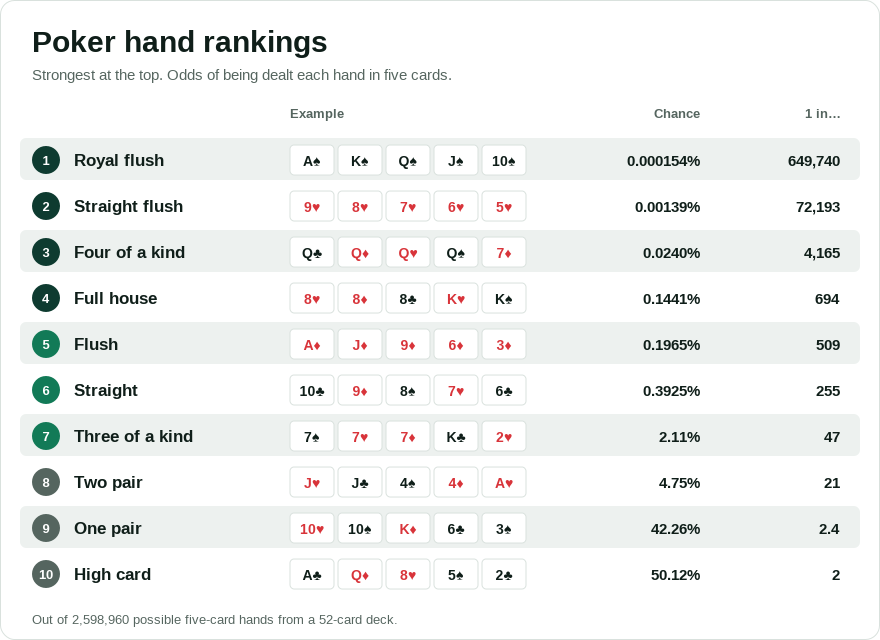
The ranking is not arbitrary: each hand is rarer than the one below it. A standard 52-card deck can be dealt into exactly 2,598,960 different five-card hands, and mathematicians have counted how many of those fall into each category. The table below gives the figures from the standard poker probability calculation for a straight five-card deal.
| Hand | Ways to make it | Probability | About 1 in |
|---|---|---|---|
| Royal flush | 4 | 0.000154% | 649,740 |
| Straight flush | 36 | 0.00139% | 72,193 |
| Four of a kind | 624 | 0.0240% | 4,165 |
| Full house | 3,744 | 0.1441% | 694 |
| Flush | 5,108 | 0.1965% | 509 |
| Straight | 10,200 | 0.3925% | 255 |
| Three of a kind | 54,912 | 2.11% | 47 |
| Two pair | 123,552 | 4.75% | 21 |
| One pair | 1,098,240 | 42.26% | 2.4 |
| High card | 1,302,540 | 50.12% | 2 |
Two things stand out. First, half of all five-card hands contain nothing better than a high card, and over 92% are one pair or worse. Second, the jump in rarity between neighbours is uneven: a flush is less than twice as rare as a straight, but four of a kind is six times rarer than a full house.
These figures are for five cards dealt straight. In Texas Hold’em you choose your best five from seven cards, so every strong hand turns up more often, but the order of the hands stays the same.
Kickers: breaking ties between similar hands
When two players have the same type of hand, compare the cards that make the hand first, then the leftover cards, one at a time from the highest. Those leftover cards are called kickers.
- One pair against one pair. K-K-9-5-2 beats Q-Q-A-J-10, because kings beat queens. If both players have kings, compare the highest other card: K-K-A-4-3 beats K-K-Q-J-10.
- Two pair against two pair. Compare the top pair, then the bottom pair, then the fifth card. A-A-3-3-K beats K-K-Q-Q-J, because aces beat kings, even though the second hand’s other cards are higher.
- High card against high card. A-K-9-7-3 beats A-Q-J-10-8. The first difference decides it.
- Flush against flush. Compare the highest card, then the next. A-9-7-5-2 of spades beats K-Q-J-10-8 of hearts.
Kickers only count if they are part of the best five cards. In Hold’em, if the board is A-A-K-K-Q and you hold J-10, your best hand is A-A-K-K-Q, the same as everyone else’s who cannot beat the board, so the pot is split.
Ties and split pots
If two hands are identical in rank after all five cards are compared, the pot is divided equally. Suits are not used to break ties in standard poker: a royal flush in spades is worth exactly the same as one in hearts. (Some home games and promotions use suit order to award a prize or decide the dealer button, but not to win a pot.)
Split pots are common in Hold’em when the best hand is on the board for everyone, for example a straight on the five community cards that nobody can improve.
Before the flop: what your two cards are worth
In Texas Hold’em the ranking only applies once you have five cards, but your two hole cards tell you a lot about what you can make. Simple counting gives the starting odds. There are 1,326 possible two-card starting hands:
| Starting hand | Combinations | How often you get it |
|---|---|---|
| Pocket aces (or any one specific pair) | 6 | About 1 in 221 |
| Any pocket pair | 78 | About 1 in 17 |
| Two suited cards | 312 | About 1 in 4 |
| Ace-king, suited or not | 16 | About 1 in 83 |
A pocket pair is already one pair before any community cards are dealt, which is why even small pairs have value. Suited cards can make a flush, but they make one far less often than new players expect, so being suited adds only a little to a hand’s strength. High cards matter because they win the kicker battles described above.
Common mistakes at the table
- Thinking a straight beats a flush. It does not. A flush is rarer and ranks higher.
- Counting more than five cards. Three pairs are not a hand; you play the best two pairs and the best fifth card.
- Wrapping a straight. K-A-2-3-4 is not a straight. The ace can only start or end one.
- Forgetting the board plays. In Hold’em you may use both, one or neither of your hole cards. If the five community cards are your best hand, you “play the board”.
- Misreading flushes. Five cards of one suit are needed. Four hearts and a diamond is just high card.
- Exposing a hand too early. In live and online cash games, the cards speak, but in a live game, turn all your cards face up at showdown and let the dealer read them.
Do the rankings change between games?
The order above is used in almost every form of poker you will meet online in Canada: Texas Hold’em, Omaha, Seven Card Stud and five-card draw. The games differ in how you build your hand, not in what beats what:
- Texas Hold’em: your best five from your two hole cards and the five community cards.
- Omaha: you get four hole cards and must use exactly two of them with exactly three community cards. Players often misread hands because of this rule.
- Seven Card Stud: your best five from seven cards of your own.
- Video poker: the same ranking pays out on a pay table, usually starting at a pair of jacks or better. See our video poker guide.
Some variants change the order. In lowball games the lowest hand wins, and in short-deck Hold’em, played without the 2s to 5s, the table rules will tell you how flushes and full houses rank. Check the rules screen before you play any unfamiliar variant.
Putting the rankings to use
Knowing the order is only the start. What wins money in poker is understanding how likely you are to make a hand and how likely your opponent is to have a better one. A few practical habits:
- Read the board first. In Hold’em, before you think about your own cards, ask what the best possible hand is. If there are three cards of one suit on the board, a flush is possible.
- Value the kicker. A pair of aces with a weak kicker loses to a pair of aces with a strong one more often than beginners expect.
- Respect the odds. Drawing to a straight or flush is a long shot on any single card. Our casino glossary explains terms such as outs and pot odds.
Online poker in Canada is available at regulated sites in Ontario and Alberta and at international sites elsewhere. Our online poker guide covers where you can play legally in each province, and the casino games hub covers the rest of the table games.
Poker and responsible play
Poker involves skill, but the cards are still random, and short-term results can swing widely. Play with money set aside for entertainment, use the deposit and time limits that regulated sites must offer, and take breaks. Our bankroll management guide explains how to size your buy-ins, and responsible gambling lists help in every province.
Frequently asked questions
What is the order of poker hands from best to worst?
Royal flush, straight flush, four of a kind, full house, flush, straight, three of a kind, two pair, one pair, and high card.
Does a flush beat a straight?
Yes. A flush is rarer, about 1 in 509 five-card hands against about 1 in 255 for a straight, so it ranks higher.
Do suits matter in poker?
Not for deciding who wins a pot in standard poker. Two identical hands in different suits split the pot.
What is a kicker in poker?
A card that is not part of your pair, trips or other made hand but still counts toward your best five cards. It breaks ties between hands of the same type.
How rare is a royal flush?
In a five-card deal, about 1 in 649,740. In Texas Hold’em, where you use five of seven cards, it comes up more often but is still very rare.
Can an ace be low in a straight?
Yes. 5-4-3-2-A is the lowest straight. An ace can be high or low but cannot sit in the middle, so Q-K-A-2-3 is not a straight.